Bad Advice from the Self Actualized
I’ve been thinking a lot about all this stuff the big AI voices keep pushing — Elon, the All In besties, Moonshots mates, everybody saying how amazing things are going to be with AI. Universal basic income, universal high income, post-scarcity. They’re right that it could be wonderful. But they also keep saying there’s going to be this huge, painful transition — layoffs, turmoil, people suffering while it all shakes out.
I know I’m not the only one sitting here thinking, why does it have to be that way? Why can’t we plan so it doesn’t suck for everybody?
Stop with the isms…
The real question nobody’s answering is: what does day-to-day life actually look like in one of these post-economic worlds? Not the theory — the actual day. We’ve got some real examples already working today that show it’s possible without everybody going broke or homeless.
First off, let’s drop the capitalism/socialism/communism labels right now. Those words just shut people’s brains off. One side hears “communism” and freaks out, another hears “capitalism” and does the same. Let’s call it what it is: a Star Trek post-economic reality. Post-scarcity. Where you don’t need money inside the community to live decently. Suspend disbelief for a minute — like Asimov said — and let’s talk about making it real instead of fighting over old ideologies.
Our current reality
Right now most of us live in places built for a totally different era. Cities grew up around old cart paths — Boston’s streets meander because they went around hills, not through them. Houses got plopped wherever, taxes pay for roads, schools, fire, police, water, power — but it’s all inefficient because nothing was planned for universality. You pay rent or mortgage because somebody owns the land. Expenses keep climbing. Throw UBI at that mess and rents just eat it up. You’re still screwed.
Communities that have already cracked the code
But look at communities that already cracked this code on a smaller scale.
Take Amish communities. They’ve been doing it for over a hundred years. Horse-and-buggy transport, shared barns, manure for fertilizer — everything’s built for the group. Kids can opt out of college at 14 and work in the community. You can leave if you want; nobody’s trapped. They fight taxation hard because if taxes kill the community, it’s gone. Religious freedom gives them exemptions, but the real magic is mutual service and low overhead. From the outside, they seem to have great longevity and happiness. Sure, maybe there’s an Amish kid somewhere full of angst in an emo outfit, but overall? It works.
Then you’ve got 55-and-over communities in Florida, Arizona, places like that. The 80/20 rule — 80% of residents have to be 55 or older — lets them skip child-related infrastructure costs. Bundled services: lawn care, trash, pest control, predictable HOA fees that don’t skyrocket for some fancy new pool. People downsize into smaller homes or mobile units. Many live fine on just Social Security. Healthcare’s closer, recreation’s there, but it’s not the Taj Mahal — just what they need.
These show you can build places where costs stay low and life stays good. So why not scale that idea around the stuff AI companies are already building — those massive data centers and power plants they’re pouring trillions into?
A possible future?
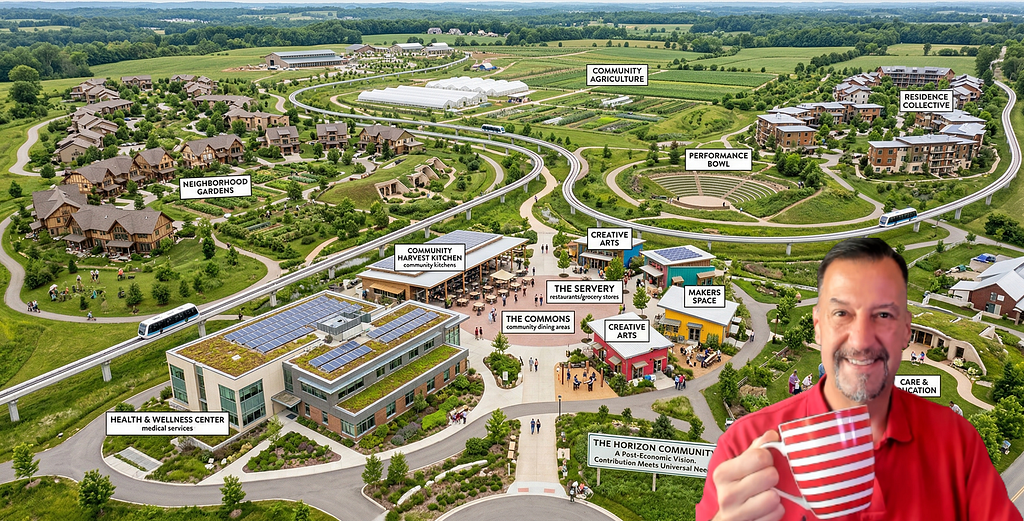
Picture this: big circles or pie slices around a data-center cluster and its power setup. One slice for young families and child-rearing: focus on education, playgrounds, parks, young-people healthcare (which is cheaper anyway), recreation. Big gardens, community restaurants, produce stands. People work in those services — gardening, running the rec programs — and get free or super-low-cost housing/services in return.
Another slice for simple living — like an “Amish option” without forcing religion. You want slower pace, no high-tech pressure? Fine. Robo-taxis handle transport when they’re ready. You serve the community somehow — light maintenance, farming — and live peacefully.
Then a 55-and-over slice: quiet, maintenance-free, on-site senior care, close to family in the other slices so grandparents aren’t isolated.
Shared stuff everywhere: huge gardens, maybe micro-grids, waste systems. Buy in once for land/housing; no rent after that. Inside the community, money’s optional — you serve, you thrive. Outside, UBI or whatever covers extras.
The AI companies building these data centers? They should build the communities right alongside. They’re already spending insane money on land, power, compute. Adding housing/community infrastructure is peanuts compared to that. They get stable nearby people for the jobs robots can’t do yet — care, maintenance, hospitality. And they actually help the people they’re displacing instead of just laying them off and saying “go be an entrepreneur.”
Not everybody’s cut out to be an entrepreneur. Peter Diamandis and the Moonshots folks say that’s the future — everybody starts businesses. Come on. That works for some, but most people aren’t wired that way. I tried starting a business after 9/11 lost my job. Made a little money, but couldn’t support my family sustainably. Ended up divorced, struggling. That’s what we’re risking on a massive scale if we don’t plan better.
We’ve got legal paths already. Use the 55+ exemptions, religious carve-outs like Amish, HOA structures, planned developments. Start small — pilot in a few states, not just one political flavor. Austin’s got Tesla stuff going; why not expand that idea? Build around data centers there, in Nevada, Arizona, Florida. Model it, tweak it, scale it.
What happens if we do nothing?
If the leaders don’t step up and help build this transition, it’s gonna get ugly. You’re laying off thousands, pushing people toward homelessness, then telling them to learn AI or start companies. Where’s the plan for everybody else? The ones who were great employees their whole lives? You can’t just kick people off the plantation and expect no pushback.
Build these communities now. Use your brains, your money, your influence. Form a coalition. Buy land around your infrastructure. Protect it from gentrification and tax creep with covenants. Make it aspirational and inspirational — not forced. Give people options: high-tech path, simple path, family path, retirement path — all close together so families stay connected.
Look at The Villages in Florida — 70 square miles, community hubs, golf carts everywhere. It’s expensive, HOA fees are high, but people buy in and get access. Now imagine that with an economic engine in the middle — a data center or factory — so it’s affordable from the start.
We need transition plans like companies do when CEOs change. Help us get there before unemployment hits 20%, 30%, 40%. Otherwise, people are gonna say, “You greedy SOBs took everything and gave us nothing.”
Pitchforks. Revolutions. Bunkers in New Zealand won’t save you from that forever.
I would happily volunteering my time. I’ll help any way I can. But we need you — the ones profiting — to lead.
Build the communities. Make the Star Trek future real, not just a sales pitch. Let’s not wait until it’s ugly. Let’s do it right now!