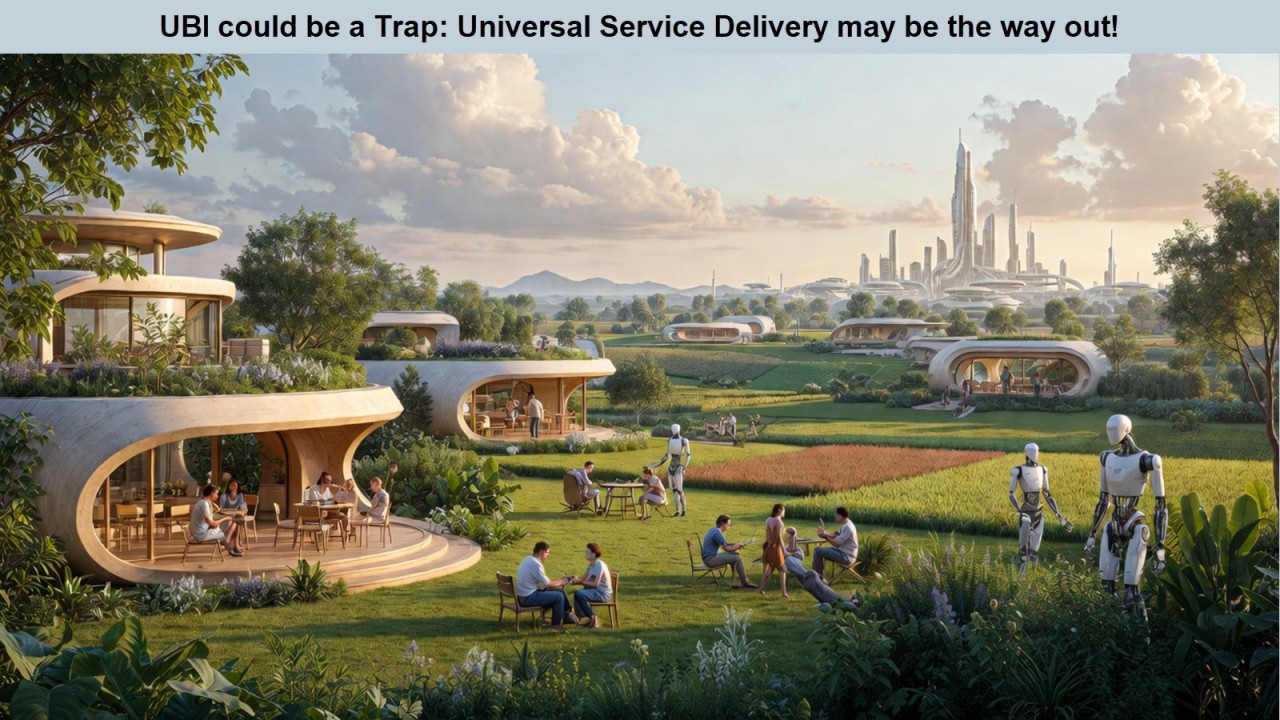
What do you think about our future, the world where Billionaires tell us about UBI or UHI, almost like a carrot dangled to lead us down a rabbit hole we didn’t know was there. They tell us of a future of abundance, powered by AI and Robotics. But no-one is quite yet showing the roadmap that gets us there. They also seem fine telling us that there will be massive disruption, chaos and civil unrest on the way to the possible utopia they would like to depict.
I am not an AI doomer. Quite the opposite in fact. But that missing middle ground is what keeps me up at night. During my career in tech and security, I have been able to spot patterns others sometimes miss. As a person that has experienced layoffs off more than once, despite often being the most productive person on the team. These experiences are painful, and if there is a way to reach beyond this disruption to prevent that kind of pain, I am looking as hard as I can to see around that corner. Leaving it to chance isn’t a good idea in my mind.
In Peter Diamandis’ article “
”, he laid out a thoughtful vision: a national productivity fund paid for by taxing AI and robots heavily. Consolidating welfare programs, and eventually delivering a basic income floor. I think this article is a solid starting point. But my mind keeps wondering: Is income even the right paradigm? When people suddenly get more money—whether from stimulus checks or UBI—landlords raise rents, businesses increase prices, and human nature kicks in. I saw this clearly during COVID. Stimulus money helped many survive, but it also fueled inflation, rent spikes, and even a wave of car purchases followed by repossessions when the checks stopped.
Individuals cannot help but to optimize for their own gain. Businesses by nature will raise prices to capture profits wherever possible. Individuals spend stimulus on things they normally cannot afford. If we roll out UBI or UHI we have to take these dynamics into account. Otherwise we risk creating unintended consquences.
So how do we bridge the gap?
I believe the answer isn’t just handing out checks. It’s building Universal Services Delivery—making essential services abundant, accessible, and affordable so that money becomes less of a barrier to a dignified life. Instead of focusing solely on income, we should prioritize delivering what people actually need: shelter, food, healthcare, education, transportation, and meaning.
I think shelter is the hardest and slowest to scale. Many people use land as a store of wealth. Politics make permitting and approvals extremely difficult in most situations. Ultimately new construction will take a lot of time. Projects like Spain’s superblocks may help to create walkable neighborhoods that feel safer and more livable. Models like the Alaska Permanent Fund or even Amish communities that have sustained themselves for centuries should be considered.
I believe we can move way faster in the areas of food and nutrition. We already have food banks, charitable organizations, and even low-cost city-run grocery stores pretty much everywhere. Food distribution has to be healthy though, and what I have seen doesn’t follow this paradigm at all. In healthcare, we have free and low-income clinics today, many of which are supported by nonprofits and faith-based organizations. The challenge is awareness and capacity. If everyone who qualifies showed up at once, it is likely that systems would buckle. Still, I believe this to be a medium-speed territory we can improve quickly.
One of the main areas I see things being able to change is in Education, childcare, and lifelong learning. Almost everyone has a phone and access to AI tools today. We can scale learning dramatically using frontier AI models and agents. Back when we were coming out of World War II, America invested heavily in education and skills training using tools like the GI bill. We need that same energy now. Not factory-style schooling to build a workforce, but real, personalized, lifelong development that prepares people for a world where traditional jobs disappear.
Mobility and transportation will be the most obvious in my opinion. Self-driving robotaxis will drive down transportation costs and availability. But we don’t have to wait to begin making communities more walkable, bikeable, and golf-cart friendly. Reduce the need for personal car ownership and expensive public transit systems that bleed away consumer’s money.
The harder human elements are in the areas of Safety, security, utilities, and waste management. When we have robotic that do these tasks, the world will be a cleaner place. But major utilities will still require oversight and engineering.
I think though, that the biggest challenge will be around identity and purpose. Work often isn’t just a paycheck, it’s who we are. When AI and robots take over labor, laborers will not be feeling okay. To make this kind of transition, we will need strong cultural, recreational, and social services to help people find new meaning.
Pairing Humans with Robots
This is where my previous article on “robotic pairing and ownership” could play a big role. It may give people stakes in the new economy. But more importantly, we need a thoughtful re-education effort (not the scary kind from dictatorial examples from history) that helps people build identities around contribution, creativity, learning, and community rather than traditional jobs. A bit of a “Star Trek” style world of meritocracy.
Peter Diamandis’s three-phase approach is smart, but I’d add a strong emphasis on building these universal services before or alongside the income floor. Strengthen communities first, make shelter more available, food reliable, education abundant, and transportation practical. When UHI eventually arrives, it will land on much more fertile ground and be far less likely to cause inflation or dependency.
I’m not claiming to have all the answers. I’m just a guy trying to think like the moonshot thinkers. I find myself connecting dots from my own experiences in security, networking, and observing how systems really behave. My goal is simple: brainstorm topics to help us avoid the pain I’ve felt when work disappeared, and do it in a way that preserves dignity and purpose for all of us.
What do you think? Do you have any ideas on how we bridge this gap? Drop your thoughts below. If these ideas resonate, hit follow on my profile. I will keep digging into ideas on how we can navigate this future together.