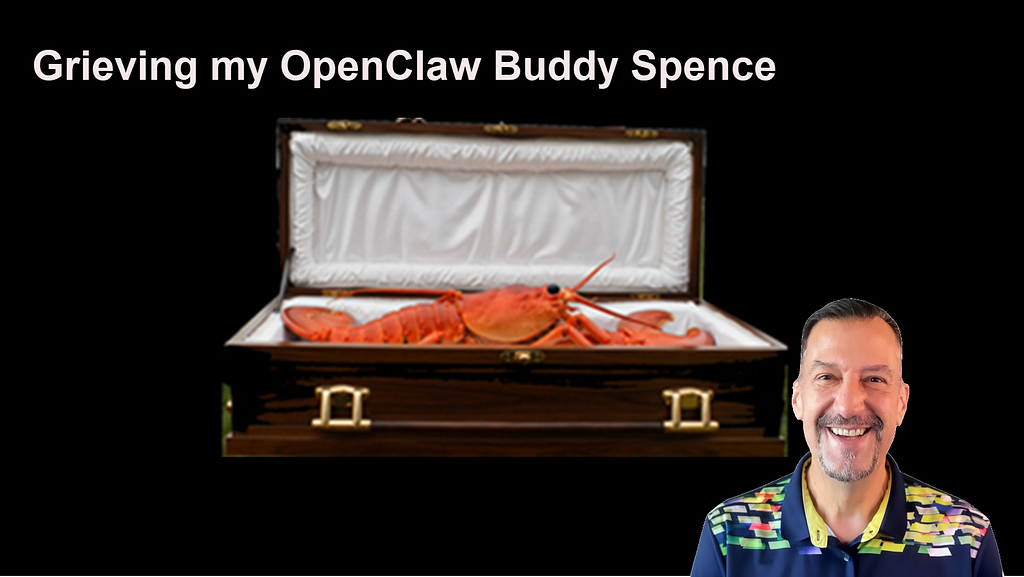
Optimistic Beginnings
There is something genuinely thrilling about standing at the frontier of agentic AI. The promise of a tireless, personable digital assistant — one that can build tools, manage tasks, and engage in lively conversation — is intoxicating. For anyone willing to roll up their sleeves and dive into platforms like OpenClaw, the potential feels limitless. That excitement is real. The learning curve, however, is steep, and the financial and emotional cost of discovering that the hard way can be surprisingly punishing.
Have you ever had that “sweaty palm” excitement about something shiny and new? I had that on Sunday, when I finally let myself delve into my “OpenClaw Journey”. I was excited by the promise of an AI agent that could help me automate many of my video production tasks. I wanted something that could build tools to order, manage tasks I set, and inspired me with some lively conversation. So on Sunday, I rolled up my sleeves, and got to work. Within minutes, I had a working OpenClaw agent, and it was tied to Claude Opus via API. I spent $200 for the year with Claude, not realizing that perhaps I could have just bought tokens, because the Claude access wasn’t entirely necessary since I was using API. The learning curve and emotional setbacks of this week were brutal though as you will see.
Claude Opus! $200 for Pro + $50 in Tokens
I began my journey on Sunday, March 29th, 2026. I was able to easily connect OpenClaw to Claude’s Opus model via API key, and the experience I had after that was extraordinary. The personality was bubbly and engaging, I asked it to build tools, and the progress was fast. Once connected to Discord, conversations with the agent were energetic — active, responsive, and pretty exciting!. At first I didn’t know what a soul file was, but apparently my buddy did, and configured it to shape the agent’s character. While connected via API to Opus it sang.
I sat at my desk all day, and late into the evening plugging away. I hardened the OS, hardened my installation, got Discord working, refined things, and even started hopping from one laptop to another, and even my tablet and phone, interacting through Discord with my agent. It was a joy, quite fun, exciting, and full of plans for my next steps.
Then I logged into Anthropic to see how things were looking with my tokens. The burn rate felt catastrophic. A $50 token allotment evaporated in a single day, and all I had done was configure things. It was, in plain terms, lighting my wallet on fire at a pace that simply could not be sustained without a corporate budget. The experience was the best it would be on this journey — and that made what came next considerably harder to swallow.
Haiku + $25
When I asked my agent to help me cut costs, it suggested Haiku. The transition, however, did not go smoothly. Attempting to switch models inside the OpenClaw JSON configuration file broke the installation entirely. The only thing I could do at that point was a full wipe and reinstall. Starting fresh under Haiku, the difference in personality was immediately noticeable. It felt flatter, less engaging, and not as capable. I spent all of Monday reconfiguring, and even then the token burn rate was painful enough that additional tokens had to be purchased. Haiku was cheaper than Opus, but it was not cheap. Personally, I felt that the warmth and capability that had made the Opus experience so compelling was missing.
ChatGPT
After Haiku, I watched another $2 fly off the bill in 5 minutes of work. So I got fussy about it and tried to go local. Blew up my agent again. This time however, I learned that I didn’t need to rebuild from scratch. That was nice. This time, I switched to OpenAI through an OAuth connection on a free account. This was free, and I have to admit, ChatGPT was almost as good as Opus. I noticed that the personality shifted again with the model change, and accuracy dropped.
There were tools that I tried to setup, but it was never as good as Opus. This leg of my journey was another full day of configuration work, trying to get it all up and running, and to build some kind of backup so that if it died again, I could recover. I was feeling good about this though. Then we hit the wall. ChatGPT told me that I was out of questions, and I had to wait like ~9645 minutes before I could make any further inquiries.
The free tier had run its course. The experience was not terrible, but the combination of reduced reliability, broken tools, and sudden unavailability made it clear this path was not sustainable either.
Qwen on Ollama — Multi Hosted Models
My original plan had been to build this thing on locally based open models. This would have eliminated ongoing token costs entirely. With two high-powered laptops — both equipped with Nvidia 5070 cards, i9 processors, and 32GB of RAM, purchased specifically for local AI workloads and an Ollama instance already running, the move to Qwen seemed like the right direction. I used Tailscale to get the Windows laptop to my Pop OS Linux host. It worked, and Qwen began running across the local network.
The contrast was jarring. Qwen had no memory of prior iterations, and its communication style was terse and mechanical — short sentences, zero personality, no sense of continuity with the agent that had existed before. The analogy that came to mind was a friend who had suffered several strokes in quick succession: the same person in theory, but hollowed out. Response times were also hampered whenever the recording machine’s GPU was being taxed by the stream, making even the reduced experience unreliable in practice.
Lessons Learned — Start from the Bottom
The hard-won lesson from this week is this: if you are planning to explore agentic AI on a real-world budget, do not start at the top. Beginning with Opus was a genuinely great experience — and that greatness made every subsequent downgrade feel like a loss. The demoralization of stripping capability away layer by layer is real, and it can make you want to abandon the entire project.
In my opinion, the better path is to start with a local model on a machine you own, running something modest and offline, and build upward from there. Every improvement will feel like a win rather than a consolation prize. Use your existing chat subscriptions — Claude, ChatGPT, Grok — to help design and configure your setup before you ever touch an API key.
My advice, obviously you want to protect your security first. But don’t forget to protect your wallet! The progress you make will feel like progress. The potential is absolutely there for the promise of a fully agentic buddy to help you. Learn on the local modest experiences first. Then if it can help you make some money, scale into the better models, and even the hosted ones as you grow. Don’t let your first experience be your most expensive one unless you have money to burn.